
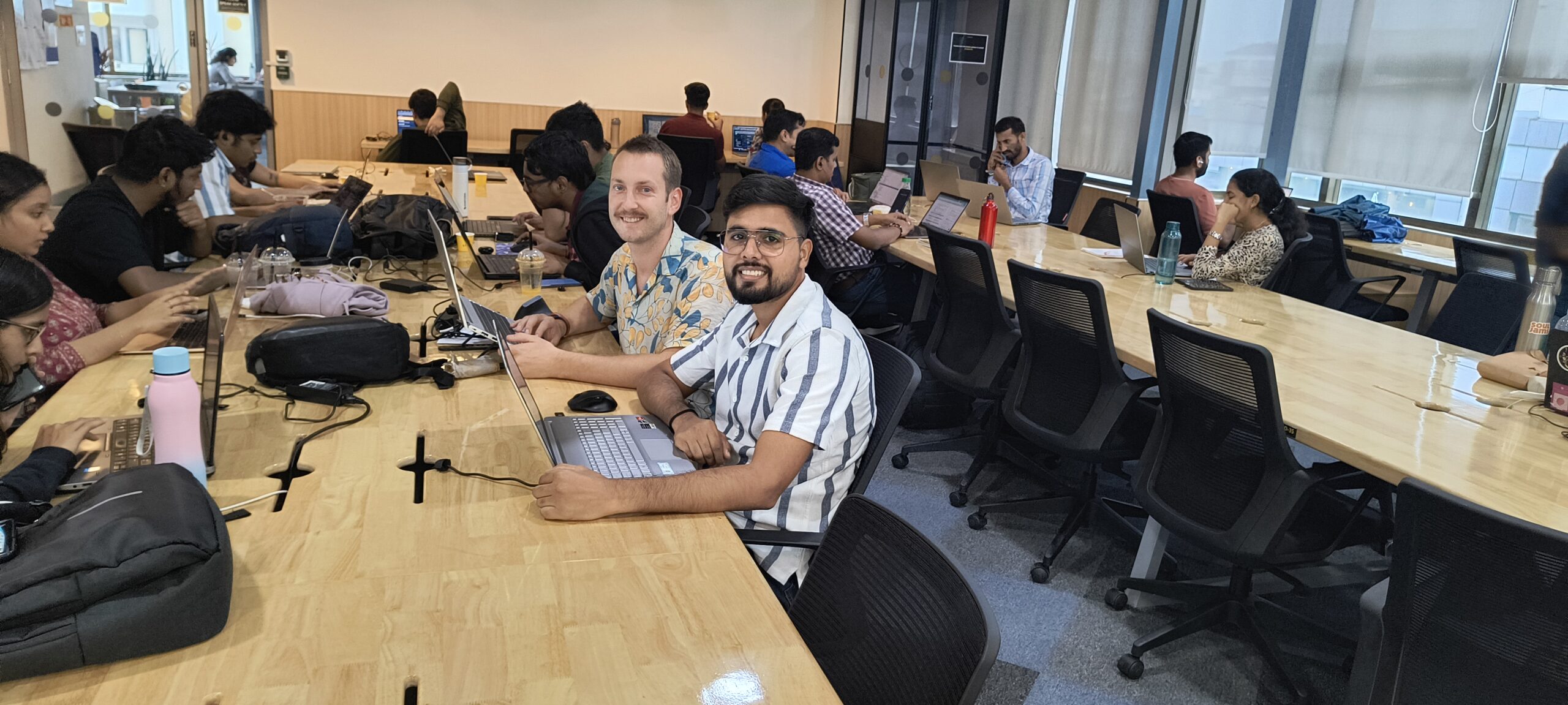
🇮🇳 The Indian Perspective – Living with AI
In India, conversations around AI carry a unique mix of excitement and worry. On the streets of Bangalore, in classrooms, and even in music studios, people are starting to feel AI’s presence in their everyday lives.
🎵 From the world of music, a young artist told us how platforms like Spotify are now filled with AI-generated songs. For her, this isn’t just technology — it’s a threat to human creativity. She values AI as a tool for research and education but believes strongly that India needs laws to protect originality and regulate AI in creative fields.
💻 From the IT sector, the story is more practical. An engineer shared how AI makes learning and work easier. Yet, he worries about the future of jobs. His point was simple: AI can automate tasks, but it will never replace human emotions — and that is where our true value lies.
📈 From marketing, we heard optimism and caution together. A professional explained how AI allows him to run campaigns more efficiently, even without deep technical expertise. But he also warned of privacy risks and the psychological cost of over-reliance. In his words, AI can do the heavy lifting, but it risks draining human focus and creativity if left unchecked.
🤖 And from within the AI industry itself, the voice is one of both responsibility and possibility. As builders of these systems, we see how AI can transform healthcare, education, and business. But we also see its flaws: bias, privacy risks, and the danger of blind trust. Importantly, India is witnessing a wave of upskilling, where professionals across industries are learning AI to make themselves future-ready. At the college level too, AI is no longer limited to IT courses — it’s becoming part of non-IT fields as well, because AI has applications in teaching, research, agriculture, business, and even creative industries. People are adapting at a large scale, eager to use AI not just for efficiency but also for expanding opportunities.
The belief is clear — AI should augment human intelligence, not replace it. And what it can never replicate is the uniquely human blend of creativity, empathy, and cultural context that defines Indian society.
Together, these voices reflect the Indian mood: hopeful about AI’s potential, yet cautious about its risks. There’s excitement about learning and opportunity, but also a shared understanding that human creativity, emotion, and originality must remain at the center of this new era.
🇳🇱 The Dutch Perspective – Balancing Innovation and Caution
In the Netherlands, AI is already woven into both professional and personal routines. In offices, IT professionals and consultants rely on Copilot and ChatGPT for analysis, writing, coding, and bug fixing. Tools from the Microsoft Power Platform are used to streamline workflows, while in daily life, AI supports tasks like grammar correction, summaries, and research. For many, AI has quickly become a natural assistant.
⚙️ From the workplace, professionals are optimistic about AI’s potential. They believe it will make knowledge more accessible and accelerate innovation, even opening doors to societal breakthroughs in areas such as medical research or the fairer distribution of resources. At the same time, many emphasize how deeply AI is already embedded in daily routines: they “use it every day in countless scenarios” and expect it to become as common as the mobile phone — a clear before-and-after moment in history.
🔒A recurring concern is data privacy — what happens if personal profiles are sold or misused for commercial gain? Questions also arise around ownership: should individuals be able to decide whether the data they share online can be used to train large language models? Another worry is what happens if AI systems increasingly train on AI-generated content rather than human knowledge — potentially creating echo chambers of machine output.
Several respondents stressed that governments should not wait until problems arise. In their view, regulation must be put in place now, to manage this revolution responsibly — especially around privacy, security, and transparency.
🧑💼 Looking to the future, several Dutch professionals expect the very nature of work to shift. Instead of doing everything themselves, people will increasingly act as orchestrators of AI agents, guiding and verifying the output rather than performing the tasks directly. This transition raises deeper questions: Will humans remain active decision-makers, or risk becoming too dependent — even passive — as AI handles more of daily life? There’s also unease about whether society is truly ready for such a workforce revolution to happen so quickly.
Despite differences in nuance, Dutch perspectives reveal a shared tension between hope and caution. On one hand, AI promises progress, efficiency, and innovation; on the other, it sparks worries about control, privacy, and the preservation of humanity in a highly automated future. Respondents stress that governments should act now to manage the revolution responsibly, rather than scrambling to fix its negative consequences afterwards.
4️⃣ Future Outlook
India: People believe AI should augment human intelligence, not replace it. There’s strong emphasis on regulation (especially in creative industries) and ensuring AI supports rather than threatens livelihoods.
Netherlands: Many expect the nature of work itself to shift — from doing tasks to orchestrating AI agents, and from searching for information to searching directly for answers. AI is expected to disrupt most industries, with enormous potential for productivity and science (big data, simulations, research). But the debate is whether this transformation will empower humans or make them too passive — and whether governments are prepared to manage it in time.
✨ The Shared Ground
Despite cultural and professional differences, both Indian and Dutch voices converge on one truth:
➡️ AI is a powerful enabler, but it comes with risks that need responsible use, regulation, and human oversight.
➡️ Across continents, people believe AI must remain a tool for humans, not a replacement of humanity itself.
➡️ The speed and scale of change create a shared concern: societies may not be fully prepared for such a rapid revolution.
👉 How do you see AI shaping the future of work and society in your own country?
📝 Note
This article is an opinion piece based on a limited set of interviews and reflections. It should not be seen as representative research, but rather as a snapshot that offers insight into the hopes, concerns, and expectations people currently express about AI in India and the Netherlands.
Geef een reactie