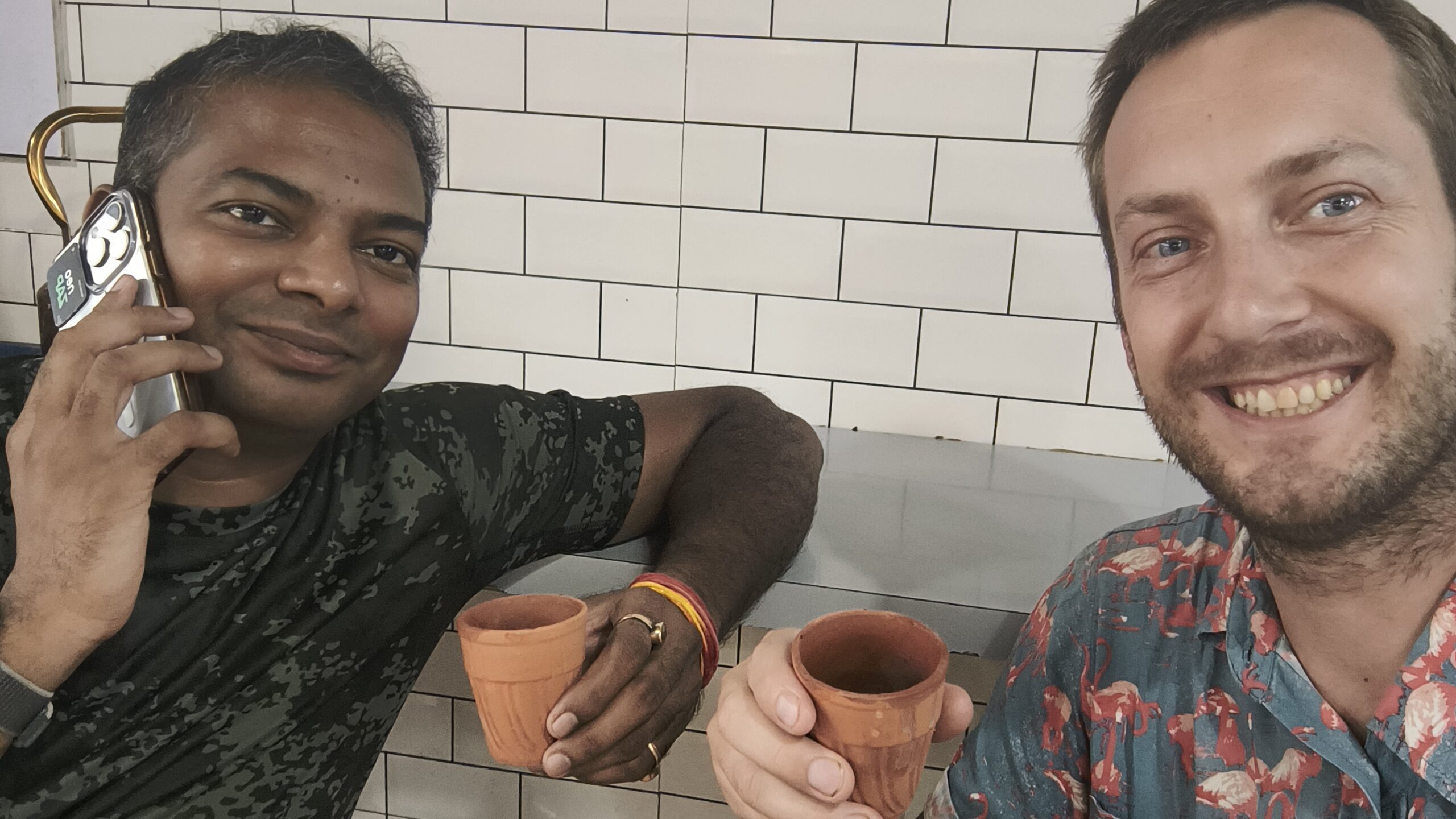
A few months ago, I shared a post looking to meet like-minded Microsoft professionals while traveling through India — ideally over a good curry🍛.
That simple idea turned into something special.
Over an Indian curry and a cup of Chai tea, I found myself in conversation with Dr. Umesh Pandit, an Azure Solution Architect. I was curious: what is it like to work from India as a Microsoft specialist, and how does he view collaboration with international clients?
With this interview, I wanted not only to capture his professional journey and vision but also to paint a picture of the person behind the screen. Who is he? How does he work? And what occupies him in daily life? In doing so, I hope to create more mutual understanding between both sides of the “online” world.
In this conversation, Dr. Umesh Pandit shares his experiences with the Power Platform, cultural differences, and the opportunities of AI. An inspiring story full of personal insights and lessons for anyone collaborating internationally.
💡I’m curious about your professional journey. How did you first come across the Power Platform, and what does your role look like today?
When I worked at Hitachi, during the period 2014–2015, there was always a strong focus on certifications. There was really a mindset that I had to continuously obtain certifications in different technologies, so that I could apply that knowledge in my work.
At that time, I worked with Hyper-V, a virtualization platform. While working with it, I noticed that there was growing buzz in the market around Azure. So, I quickly decided to obtain the Azure Cloud certification as well. I still remember walking to the certification center during my lunch break, since it was located near our office. I took the exam, passed it, and went straight back to work afterwards. I think I was even one of the first chartered members to earn that certification. If you look at my Microsoft transcript, you can still see it there.
In 2015, I ended up on the Microsoft campus, where I first became involved with CRM activities. Shortly after, I was sent to Singapore to work on SQL servers, CRM systems, and SharePoint. In that project, we also implemented connectors, including for a timesheet and quality management application. The foundation of all that work was already Azure, and from that moment my journey in the Power Platform began.
Today, I work as a Solution Architect, advising clients on the Power Platform, Azure, and data. That means I spend a lot of time on APIs, governance, data integration, Azure databases, data management, Azure Synapse, CRM, and dual-write scenarios. I also regularly take on the role of trainer. For example, together with Microsoft Reactor in Sydney and the CRM and Power Platform team, I gave a comprehensive live demo. We showed the entire cycle — from creating a lead in CRM, through the flow toward an opportunity, to the final conversion in Dynamics using Dual Write. A complete setup and ecosystem, presented live to an international audience.
⚙️You’ve mentioned your expertise in the Power Platform and Azure. Could you tell us more about the kind of applications and solutions you usually create with Microsoft technology?
The solutions I work on are mainly within the Power Platform and Azure. Many clients still have their CRM systems running on-premises, which means they incur high infrastructure costs. What we do is help them move these systems to the cloud.
We often use a lift-and-shift strategy. This means that the entire application is migrated from on-premises servers to Azure, without having to rebuild everything from scratch. This provides clients with a much cheaper and more efficient solution, as they no longer need to maintain local servers.
In practice, these are often clients with very large data sets — sometimes 4 to 10 terabytes of CRM data. During such a migration, we carefully look at capacity planning and cost control. With the help of Azure Site Recovery and Azure Migrate, we can move systems to the cloud, with data stored in Azure Blob Storage as part of a disaster recovery solution.
The advantage is that clients can continue to use their familiar CRM versions (for example CRM 2013 or 2015), but now hosted in Azure. The functionality remains the same as in their on-premises environment — only now in a cloud environment that is much easier and cheaper to manage.
“Western clients are open and supportive, but collaboration only works when trust is established.”
🤝You’ve worked with many international clients. How do you experience working with Western customers, and what challenges or cultural differences do you notice in collaboration?
What strikes me about Western clients is that they are generally very approachable and supportive. Collaborations start easily, support is offered quickly, and they share their screens without hesitation to explain issues. Of course, when it comes to confidential information, there is some initial caution, but once trust is established, collaboration usually runs smoothly.
“Trust is the foundation — once it’s there, collaboration flows naturally.”
Another interesting aspect is that clients often bring more options to the table than you might expect. I’ve led sessions where companies realized they could achieve a lot with their existing Power Platform licenses, without having to invest in custom solutions. Those moments often create valuable awareness.
International collaboration, however, also comes with challenges. The biggest one is communication: many clients speak very fast, which can make it difficult to follow everything. Nowadays, the transcription feature in Microsoft Teams helps enormously, since conversations are automatically written out.
“Technology helps bridge the gaps — tools like Teams transcription have changed the game.”
Beyond communication, cultural differences also play an important role. In Europe, people tend to start their workday earlier, value healthy routines, and usually communicate in a positive and constructive way. Punctuality is strictly observed — if a meeting is at 10:00, it starts at 10:00 — while in India, arriving five minutes later is perfectly normal.
But the most striking difference is hierarchy. In India, it’s common to consult your manager first, and stepping directly to a client can be seen as bypassing authority. In the Netherlands, by contrast, direct initiative is valued and even encouraged. I once had a Danish manager who showed me how open, friendly, and people-oriented leadership in Europe can be. He would always ask about my well-being and family before discussing work. That openness gave me a lot of trust — something that has stayed with me and stands in sharp contrast to the more formal and hierarchical work culture I’ve experienced in India.
“In Europe, direct initiative is encouraged — in India, hierarchy still carries more weight.”
🕐Let’s zoom in on the day-to-day. What does a typical workday look like for you when collaborating with international clients?
That has become quite normal nowadays, but it requires good organization and preparation. If, for example, a meeting about the Power Platform is scheduled, I make sure I know exactly what is going on in advance. Sometimes it’s about misassigned licenses, sometimes about other issues — I need to be prepared to discuss them.
I usually start my day early with an internal stand-up and then move straight into client meetings. Beforehand, I gather the most important information and determine whether the meeting is mainly a discovery call or a presentation. In a discovery call we map out needs, while in a follow-up conversation I present the solution or deliver what the client has requested, such as a short training or documentation.
“Don’t fear AI — learn how to use it to strengthen both your career and your company.”
🤖AI is everywhere these days — are you already applying it in your Power Platform solutions?
AI hasn’t been fully implemented in all my projects yet, but I closely follow its developments. In practice, I already use Copilot and other AI tools as support during the design process — for example, to find the right documentation more quickly or to validate architecture choices. When Copilot doesn’t have access, I combine it with sources like Microsoft Learn or other references. In this way, AI helps me mainly as a sparring partner and accelerator.
For clients, I see the biggest opportunities in AI-driven agents and copilots that are increasingly being rolled out within the Power Platform. A concrete example is a knowledge-based chatbot that can provide answers based on the latest documentation and regulations. With that, a client — for example, a security company — can immediately receive an answer with the correct underlying document links. That saves a lot of time and increases service quality.
Looking at the next two years, I see AI playing a supporting role. The goal is not to replace people but to make their work easier and more efficient. For managers and consultants, this means learning to apply generative AI in their daily work. That will not only strengthen their careers but also the future of their companies. My advice: don’t be afraid that AI will take your job — learn how to use AI to do your job better.
“India should be seen not just as a resource, but as a strategic partner for innovation.”
🌍Looking beyond technology, collaboration itself is key. What advice would you give to European or Dutch companies that want to work with Indian experts?
I think European and Dutch companies already collaborate a lot with India in various technology areas. My main advice would be to deepen and expand that collaboration further. India offers a huge pool of knowledge and expertise, and by truly working as partners instead of merely in a client-contractor relationship, you get the most out of it.
India is a peaceful country; we do not support war and focus strongly on cooperation and development. For European companies, there are many opportunities to set up development centers in India, especially because there is already a strong foundation in production, export, and import. Instead of focusing only on cooperation with the United States or China, there is much to gain by investing more in India.
What helps companies is organizing knowledge exchange and building sustainable partnerships. This not only ensures good solutions but also long-term relationships.
Moreover, working with India has practical advantages: due to the time difference, Indian teams can continue working while Europe sleeps, resulting in faster project delivery. At the same time, there is room to maintain a good work-life balance, something increasingly valued in India.
“What I enjoy most is the balance: finishing projects on time and still having quality family time.”
💬On a personal note, what do you enjoy most about working internationally?
What I enjoy most is that, when you are well-organized, you can actually finish your work on time. That brings peace of mind and allows for a healthy work-life balance. A big advantage is also the time difference: I start my day early with an internal stand-up and then focus on international projects. By midday, I’m usually done with the most intensive client activities, which means I can dedicate the rest of the day to my family. That combination — working internationally, completing projects within deadlines, and still having quality time at home — is what makes collaborating with clients from India so unique and fulfilling for me.
🔧Finally, what’s a typically Indian element you bring to your work?
What I consider typically Indian in my way of working is that I always act directly and solution-oriented. When a problem arises, I want to solve it as quickly as possible without wasting time. Lost time costs money and creates frustration, so I get to work immediately to fix it.
One example was an incident in Australia, in the middle of the night. Everyone was still asleep, but I took responsibility myself: I restarted the system, immediately created a P1 ticket, and solved the problem within ten to fifteen minutes. The next morning, both management and the client were satisfied — a lot of time and money had been saved, and I even received a bonus for it.
That kind of direct, pragmatic action — which you often see among Indians once they are given responsibility — is something I bring into all my projects. We take our responsibility seriously and focus straight on the goal: helping the client as well and as quickly as possible.
Geef een reactie